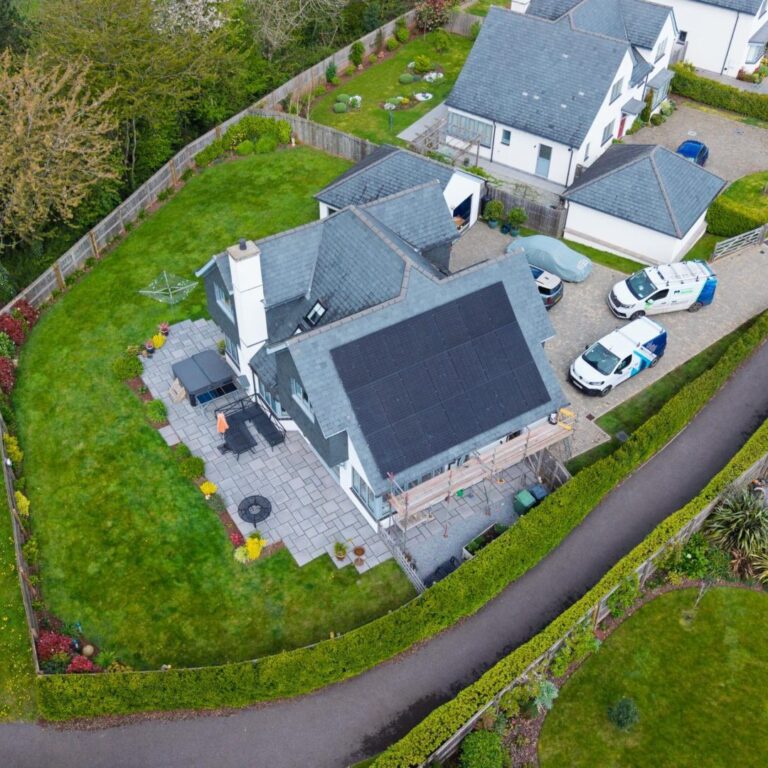
Dartmouth is one of South Devon’s sunniest and most sought-after coastal towns. Its hillside position above the Dart estuary, sheltered from north winds and facing broadly south-west, gives it some of the best solar generation potential of any Devon coastal town. For homeowners and holiday let owners in Dartmouth and the TQ6 area, solar panels are an investment that makes strong financial sense on the right property.
Why Dartmouth is well-suited to solar
The south and south-west facing hillside streets above the Dart produce excellent panel output across the year. Dartmouth receives around 1,600 sunshine hours per year, at the higher end for Devon, and comfortably above the UK national average of around 1,340 hours. A well-positioned 4kWp system on a Dartmouth hillside roof generates around 3,700 to 4,200 kWh per year.
One important factor for Dartmouth installations is that many of the town’s most desirable properties are Victorian and Edwardian, and a number are listed or within the conservation area. For listed buildings, listed building consent is required before any installation. For conservation area properties, the planning position depends on whether the panels would be visible from a highway. We check this for every Dartmouth property at the survey stage — and in most cases, the rear or side slopes that generate best solar are not visible from the road.
Holiday let solar in Dartmouth
Torbay and South Hams have one of the highest concentrations of holiday lets in England, and Dartmouth is no exception. The town and its surrounding villages: Kingswear, Stoke Fleming, Blackawton, Torcross, have significant holiday accommodation stock ranging from harbour-view apartments to larger country properties.
For holiday let owners, solar panels reduce electricity costs during high-occupancy summer periods when guests have appliances running continuously, and increasingly satisfy both insurer requirements and the environmental expectations of guests. Properties with solar panels are listing on Airbnb and holiday booking platforms with an explicit sustainability angle that attracts the growing segment of travellers who factor this into their decisions.
MCS certification of the installation is important for holiday let owners. An MCS certificate documents the system to the standard your insurer will recognise and provides the paperwork that specialist holiday let insurers increasingly ask to see.

Solar and battery storage in Dartmouth
For a holiday let property that sits empty out of season, battery storage makes a different case than for an owner-occupied property. Self-consumption in an empty property is low, so a battery does not add the same value it would for a full-time resident. For owner-occupied properties in Dartmouth, particularly those with an EV charger, battery storage improves the financial return considerably.
For larger holiday lets with significant summer-season electricity use, the combination of solar and battery means any generation surplus to guest demand is stored and used rather than exported at the lower SEG rate.
How far is M&E Contrax from Dartmouth?
We are based in Newton Abbot, 20 miles from Dartmouth via the A381. Our team works across South Hams regularly and can usually arrange a survey visit within a week of enquiry. For Dartmouth properties with access constraints on the steeper hillside streets, we plan access and scaffolding as part of the pre-installation survey.
Book a free solar survey in Dartmouth
Call 01364 654271 or contact us online. We cover Dartmouth, Kingswear, Stoke Fleming, and all TQ6 postcodes from our Newton Abbot base.
MCS Accredited | NICEIC Approved | Newton Abbot, Devon | 20 miles from Dartmouth
Written by Lee Bullingham, Solar PV Installation Lead, M&E Contrax Renewables. Published September 2026.