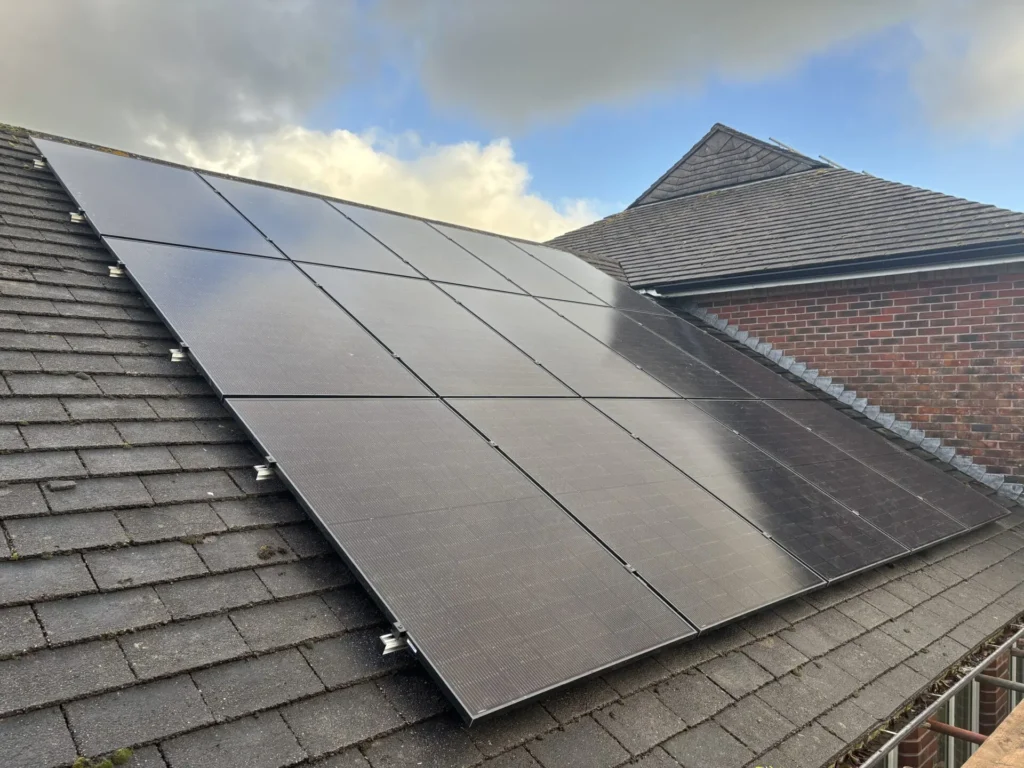
If you’re thinking about solar panels in Newton Abbot, one of the first questions you’ll ask is whether your roof is suitable.
The good news is that many roofs are. Solar does not need a perfect, south facing roof with no shade to be worthwhile. What matters is understanding your roof shape, direction, available space, and any shading, then designing a system that suits how your property actually uses electricity.
This guide covers the practical checks we look at in a solar survey, and what different roof types mean for performance and installation.
Looking for solar panel installation in Newton Abbot?
Start here: Solar Panels Newton Abbot
In Short
- The “best” roof depends on direction, shading, and usable space, not just postcode.
- East or west roofs can still work well, especially with the right system size and usage pattern.
- Slate, tile and flat roofs can all be suitable, but fixing methods and design differ.
- Dormers, chimneys and roof windows reduce usable space, but do not necessarily rule solar out.
- A proper survey confirms what is possible and avoids guesswork.
1) Roof direction, does it need to face south?
South facing roofs are often seen as the ideal because they can produce strong generation across the day. But in real homes and businesses, other roof directions can still work extremely well.
South facing
- Strong overall generation
- Good spread of output across daylight hours
- Often ideal for households that use power during the day and early evening
East facing
- Higher generation in the morning
- Often suits households that are active earlier in the day
- Can pair well with battery storage to move excess into the evening
West facing
- Higher generation later in the day
- Often suits families who use more power after school or work
- Can be helpful for businesses that operate later hours
East and west combined
Many Newton Abbot homes and commercial buildings have roof shapes that allow panels on more than one face. This can spread generation more evenly across the day and sometimes improves self consumption.
The main question is not “is it south?” but “how will generation line up with your electricity use?”
2) Roof pitch, does angle matter?
Roof pitch affects how sunlight hits the panels across the year. Most pitched roofs work well for solar, and the angle is rarely a dealbreaker on its own.
What matters more is:
- direction and shading
- usable space
- panel layout and positioning around roof features
A survey will confirm your roof pitch and design around it.
3) Shading, the biggest factor people underestimate
Shading is one of the most important things we assess because it directly affects output.
Common sources of shading in Newton Abbot include:
- chimneys
- dormers
- roof valleys and hips
- trees
- neighbouring buildings
- overhead cables or tall structures nearby
The key point
Some shade does not automatically mean solar is not suitable. It means the design needs to account for it.
In many cases, good panel positioning, split arrays, and the right system setup can still deliver strong results. The worst approach is ignoring shade at quotation stage, because that can lead to unrealistic expectations later.
If you want to understand performance factors in more detail, read:
What affects solar panels and their performance in Newton Abbot
4) Slate vs tile roofs, what is the difference?
Both slate and tiled roofs can be suitable for solar. The difference is mostly about fixing methods, access, and workmanship.
Slate roofs
- Often found on older or character properties
- Require careful handling to avoid breakage
- Fixings and flashing details need to be done properly
- A tidy finish matters, especially on visible roof faces
Tiled roofs (clay or concrete)
- Common across many Newton Abbot homes
- Generally straightforward for solar mounting systems
- Still needs correct fixing and weatherproofing, especially around hooks and penetrations
In both cases, the quality of the installation is everything. A good solar install should look neat, sit properly, and protect the roof.
5) Flat roofs, are they suitable for solar?
Yes, many flat roofs are suitable, and they are often used for commercial solar installations.
Flat roof systems typically use mounting frames to angle panels. The key considerations are:
- structural loading and wind uplift
- ballasted vs fixed systems
- access and safe working setup
- maintaining roof drainage and avoiding obstruction
- visibility and any planning considerations where relevant
Flat roofs can work very well, but they require correct design and professional installation planning.
6) Dormers, roof windows, and awkward roof features
Dormers, roof windows, chimneys and vents reduce the usable panel area, but they rarely rule solar out completely.
A good design will:
- keep clear of shading hotspots
- create a layout that looks tidy and intentional
- maximise usable space without forcing panels into poor positions
- sometimes use more than one roof face to achieve the right system size
If your roof is complex, this is where a survey is essential. What looks impossible from the ground often has good options when measured properly.
7) How much roof space do you actually need?
This depends on:
- how much electricity you use
- whether you want a battery
- whether the system is for a home, business, or both
- how much space is usable once roof features are accounted for
Some people aim to cover as much roof as possible. Others aim to match a system size to their usage. There is no single right answer, it depends on your goals.
8) A quick roof suitability checklist
If you want a simple sense check before booking a survey, ask yourself:
- Do I have a clear roof face with decent open space?
- Is there heavy shading from trees or buildings for large parts of the day?
- Do I have multiple roof faces, east and west, or south and west?
- Is the roof in good condition, with no obvious issues?
- Would I consider battery storage now or later?
- For a business, is daytime electricity use significant?
If the answer is mostly yes, there is a good chance solar will work well, but the survey confirms it properly.
Frequently Asked Questions
Do solar panels work on east or west facing roofs?
Yes. Many east and west roofs work very well, especially when matched to your electricity usage pattern.
Will shading ruin solar performance?
Not always, but it must be assessed and designed around. Some shading is manageable with good layout and system setup.
Can solar panels be installed on slate roofs?
Yes, but slate needs careful handling and correct fixing methods to protect the roof and achieve a tidy finish.
Are flat roofs suitable for solar?
Often yes. Flat roof solar needs the right design for wind loading, roof integrity, access and drainage.
What if my roof has dormers or roof windows?
You may still have plenty of usable space. A good layout works around features and shading hotspots.
Next step, book a solar survey in Newton Abbot
If you want to know for sure whether your roof is suitable, the best next step is a proper survey and a clear layout plan.
You can also explore:


