M&E Contrax Resources
Solar Panels for Devon Farms and Agricultural Buildings

Resource Highlights:
Devon’s irradiance advantage applies just as much to farm buildings as it does to homes, with Exeter receiving 13% more solar radiation per year than the UK average.
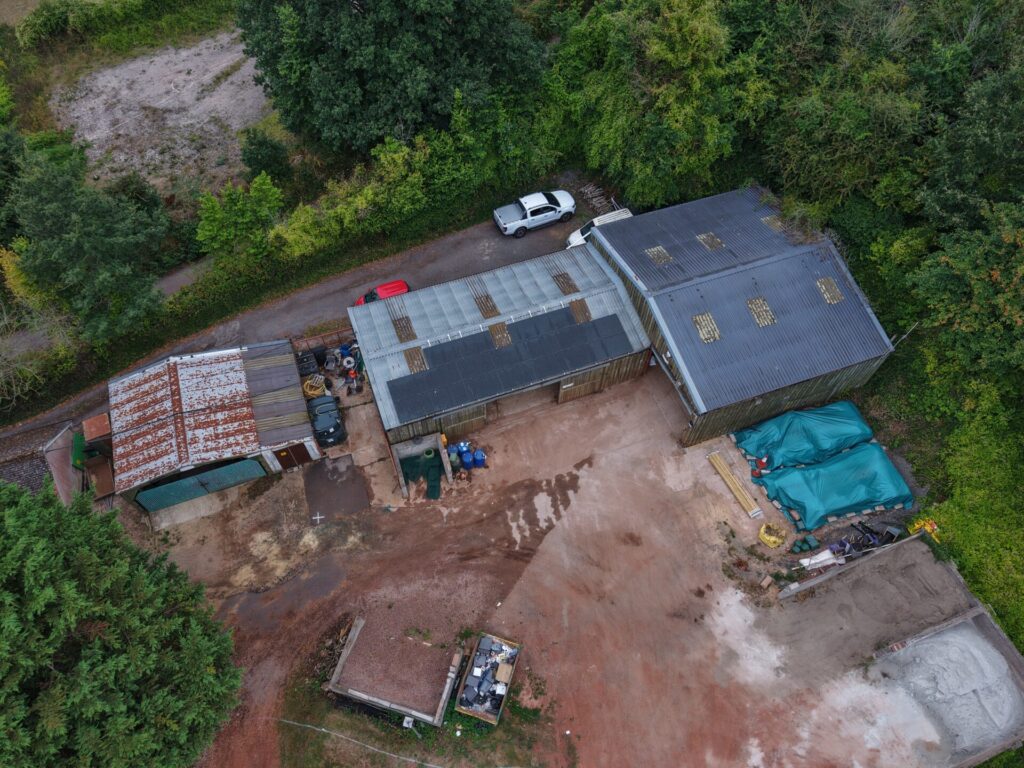
Agricultural barn roofs are often ideal for solar: large, uninterrupted, south-facing surfaces that carry no dormer windows or roof lights to work around.
Rooftop installations on most agricultural buildings qualify as permitted development, meaning no planning application is required.
Tax relief: The Annual Investment Allowance allows most farm businesses to deduct the full cost of a solar installation from taxable profits in the year of purchase, up to the £1 million annual limit.
The practical guide to agricultural solar in Devon
Devon farms are well placed to benefit from solar. The county receives more sunlight than almost anywhere else in the UK, farm buildings often offer large unobstructed roof areas, and most farming operations have the kind of predictable daytime electricity loads that match well with what solar panels generate.
This guide covers the main installation options, what affects whether planning permission is needed, how the DNO connection process works for larger systems, and the commercial case for rural Devon businesses. It is aimed at farm owners and managers who want clear, practical information before deciding whether to commission a survey.
Why Devon farms are well suited to solar
The financial case for solar improves with the amount of sunlight a location receives. Devon sits near the top of the UK rankings. Exeter receives 1,237 kWh/m² of solar irradiance annually, which is 13% above the national average, and sees around 1,552 hours of sunshine each year. That extra generation per panel directly shortens the payback period compared with an equivalent installation in the Midlands or the North.
Farm operations also tend to have high electricity use during daylight hours. Milking equipment, refrigeration, ventilation fans, grain drying, water pumping, and workshop machinery typically run when the sun is out. This alignment between generation and consumption is important: electricity used on site displaces grid electricity at the full unit rate, which is worth considerably more than electricity exported to the grid. The closer a farm’s usage profile is to its generation profile, the stronger the financial case.
The roof areas available on typical Devon agricultural buildings are also substantially larger than anything available on a domestic property. A single steel portal frame barn with a south-facing pitch of 30 to 40 metres can accommodate a significant array, often large enough to address a meaningful proportion of the farm’s total electricity demand.
“48,255 Devon households have had MCS-certified solar installations as of May 2024 — 10% of homes in the county, more than double the UK average. The case for farms, with larger roof areas and higher energy loads, is even stronger.”
Barn roofs and agricultural buildings
What makes an agricultural roof suitable?
Before any system is designed, an installer will assess the roof against several practical criteria. Understanding these in advance helps farm managers prepare for a survey conversation.
Roof orientation and pitch. A south, south-east, or south-west facing elevation performs best. East-west splits across a ridged building can still work well, with panels on both sides extending the generation window across the day and reducing the morning and evening dips in output.
Structural condition. Steel portal frame buildings, which make up the majority of agricultural construction in Devon, are generally well suited to standard solar mounting systems. Older buildings with timber purlins or corrugated asbestos cement sheet cladding require structural assessment before installation is confirmed. Any building with asbestos cement roofing will need an asbestos survey before any fixing or drilling work begins.
Roof covering type. Box profile and corrugated steel are the most common agricultural coverings and accept standard through-fix mounting rails cleanly. Standing seam metal roofing can accommodate clamp-based systems that attach without any roof penetrations at all, which is particularly useful on buildings where watertight integrity is critical. Fibre cement sheets require specialist fixings and should be assessed on a building-by-building basis.
Available span and panel rows. Larger continuous roof spans allow more efficient system layout with shorter cable runs between panel strings. This reduces installation cost per kilowatt-peak and simplifies the inverter configuration.

Permitted development for agricultural buildings
Most barn and farm building rooftop installations qualify as permitted development and do not require a planning application. The key conditions are that panels must not project more than 200mm from the roof slope and must comply with the relevant placement guidelines for the building type.
This is a practical benefit that is often underestimated. No planning fees, no eight-week wait, and no risk of objection. For most straightforward agricultural rooftop installations, the DNO application timeline is the main programme constraint, not planning.
The main situations where permitted development does not apply are:
Buildings within the curtilage of a listed farmhouse, where listed building consent may be required
Buildings in a conservation area where the relevant roof elevation faces a highway
Buildings within or on the boundary of Dartmoor National Park or Exmoor National Park, where additional conditions apply
Devon has a significant number of farms that fall near or within these designations, particularly in the South Hams, on the fringes of Dartmoor, and in parts of North Devon. If there is any uncertainty about designation, a quick check with the local planning authority or a pre-application enquiry will confirm the position before any cost is committed.
Ground-mounted solar on farm land
Ground-mounted systems are an option when the available roof area is insufficient for the farm’s energy needs, when roof condition or orientation limits rooftop output, or when there is lower-productivity land that is not required for grazing or cropping in the medium term.
Planning permission for ground-mounted systems
Unlike rooftop installations, ground-mounted solar on agricultural land almost always requires full planning permission from the relevant local planning authority, which for most Devon farms will be one of the district or borough councils.
Devon County Council has published landscape guidance for solar PV developments, which sets out how proposals should respond to Devon’s distinctive rural character. The guidance encourages the retention of existing Devon hedgebanks, respect for historic field patterns, and the use of native planting to screen sites where visibility from public roads or footpaths is a consideration. Large amalgamated field layouts that remove boundary features are likely to face greater scrutiny than proposals that work within the existing landscape structure.
For farms within or adjacent to designated landscapes, including the South Devon, East Devon, and North Devon Areas of Outstanding Natural Beauty, and the Dartmoor and Exmoor National Parks, landscape sensitivity is a primary consideration in planning decisions. Proposals in these areas are not automatically refused, but they require careful site selection and a well-prepared application that demonstrates the visual impact has been genuinely addressed.
Land quality classification also matters. Government planning guidance encourages solar development on lower-grade agricultural land, classified as Grade 3b, 4, or 5, rather than higher-grade productive land. Many Devon farms hold a mix of grades across their holding, and a land quality assessment can identify which parcels are most suitable for a ground-mounted array without compromising productive capacity.
Pre-application discussions with the local planning authority are strongly recommended for any ground-mounted proposal. They reduce uncertainty, identify potential issues early, and can significantly improve the chances of a smooth application.
Agrivoltaics and continued land use
There is growing interest in combining solar generation with continued agricultural use beneath and around a ground-mounted array. Sheep grazing beneath panels is well established and is accepted by most planning authorities as evidence that agricultural land use is being maintained alongside energy generation.
Panel height and row spacing affect what is practical beneath the array. If retaining grazing or managing ground-level vegetation is a priority, this should be raised at the design stage so the mounting structure can be specified accordingly.
Solar farms have also been shown to support biodiversity when managed appropriately. Reseeding with species-rich wildflower and grass mixes between and around panels creates habitat for pollinators and other wildlife, and can strengthen a planning application by demonstrating positive environmental outcomes beyond energy generation.
DNO considerations for farm solar
The Distribution Network Operator connection process is consistently one of the least understood aspects of agricultural solar, and one where early action matters most. Delays in this area are the most common cause of project programme slippage.
G98 and G99 explained
G98 covers systems with an inverter output below 3.68kW per phase. For these, the process is straightforward: install first, then notify the DNO within 28 days of commissioning. This covers very few agricultural installations of any meaningful size.
For systems on a three-phase supply, which is most farm properties in Devon, the G98 threshold extends to 11.04kW. Any system above this level requires a G99 application, which must be submitted and approved before the installation can begin.
G99 is a formal application to the DNO covering the technical specifications of the proposed system, the connection design, and the grid impact assessment. The DNO has a statutory obligation to respond within 45 working days, though real-world timescales in Devon and the South West have sometimes extended to four to six months during periods of high application volumes. The Distribution Network Operator for Devon is National Grid Electricity Distribution (formerly Western Power Distribution).
The practical implication is straightforward: the G99 application should be submitted as early as possible in the project timeline, ideally before the planning application is determined for ground-mounted systems, and before installation is scheduled for rooftop systems.
Export limitation and rural grid constraints
Rural grid connections in Devon, particularly in more remote parts of the county including parts of North Devon, Dartmoor fringes, and the South Hams, sometimes have limited capacity for electricity export. Where this is the case, the DNO may issue a connection offer that includes an export limitation condition.
An export limitation does not prevent the system from being installed or operating. It places a cap on the amount of electricity the system can push back to the national grid. The system continues to generate normally for self-consumption; only the export element is restricted.
For farm installations where the primary goal is reducing electricity costs rather than generating income from export, an export limitation may have limited practical impact. A system sized primarily to serve on-site demand will export relatively little in any case. It is worth discussing the farm’s expected generation and consumption balance with the installer at the design stage, so the G99 application can be prepared with realistic export figures.
Where the DNO determines that the system’s export needs to be limited, a G100 condition is added to the connection offer. This requires an export limiting device to be installed alongside the solar system. This adds a small amount to the installation cost and programme but does not otherwise affect the system’s performance for self-consumption.
Three-phase supply and system design
Most farm properties have a three-phase electricity supply, which affects both the system design and the DNO application. Three-phase systems allow larger inverter capacity per connection and distribute generation more evenly across the supply. This is particularly relevant for farms running motors, compressors, and refrigeration equipment, where uneven phase loading can cause performance issues with sensitive machinery.
At M&E Contrax, we hold NICEIC accreditation and manage the G99 application as part of the installation process. We prepare the technical documentation, submit to National Grid Electricity Distribution, and handle any follow-up queries. You do not need to navigate the DNO process yourself.

The commercial case for farm solar in Devon
Reducing operational electricity costs
Electricity is a significant overhead for many Devon farm businesses. Commercial electricity rates have been volatile and remain elevated compared to the rates many farm businesses were paying five or ten years ago. Solar does not eliminate electricity costs, but it replaces a proportion of grid electricity with generation that has no ongoing fuel cost.
The financial case is strongest where a high proportion of what the system generates is used on site. A farm that can absorb most of its solar generation into daytime operations is saving at the full unit rate on every kilowatt-hour consumed. A battery system can extend self-consumption further into evenings and early mornings, which is worth considering for farms with refrigeration or ventilation loads that run overnight.
Capital allowances and tax relief
Capital allowances are one of the most significant financial levers available to farm businesses investing in solar, and they are frequently underused or poorly understood.
Solar panel installations qualify as plant and machinery for capital allowances purposes. Under the Annual Investment Allowance, businesses can deduct the full cost of qualifying capital expenditure from taxable profits in the year of purchase, up to a permanent limit of £1 million per year. For most farm solar installations, the full cost will sit comfortably within this limit.
The practical effect is that a meaningful proportion of the investment cost is offset by tax relief in the first year. For a sole trader farmer paying higher-rate income tax, the saving rate is 40 pence for every pound of qualifying expenditure. For a company paying corporation tax at 25%, the saving is 25 pence per pound.
Solar panels are classified as special rate expenditure under HMRC rules, which means they do not qualify for the 100% full expensing introduced in 2023 for main rate assets. They do qualify for the AIA up to £1 million, and for a 50% First Year Allowance on any expenditure above the AIA limit for businesses with very large investment programmes.
It is important to take advice from your accountant on the timing and structure of the capital allowance claim, particularly where an investment falls across more than one accounting period or where AIA has already been used on other plant and machinery in the same year.
A 10-year exemption from business rates on new rooftop solar installations is in effect until 2035. This means a rooftop installation will not increase the rateable value of the building to which it is attached. Ground-mounted arrays may be treated differently for rating purposes, and the position should be confirmed with the Valuation Office Agency.
Energy security and long-term price stability
Beyond the immediate savings, there is a risk management argument for farm solar that is worth considering. Farm businesses are exposed to energy price volatility in a way that directly affects operating margins. Grid electricity prices are subject to changes in wholesale energy markets, network charges, and policy costs, none of which are within the control of a farm business.
A solar installation converts a portion of the farm’s electricity consumption into a known cost basis for the life of the system, typically 25 years or more. The generation profile is predictable in a way that tariff movements are not. For businesses managing tight margins and long-term capital planning, that predictability has a value that sits alongside, but is separate from, the headline payback calculation.
Environmental credentials and supply chain requirements
Solar installations on farm businesses sit well alongside the broader direction of agricultural policy and increasing supply chain expectations around environmental performance. Many supermarket and food processor contracts now include environmental reporting requirements, and solar generation is a practical and verifiable contribution to a farm’s sustainability credentials.
The Sustainable Farming Incentive and other DEFRA schemes have increased the focus on environmental land management. While solar is not directly funded through SFI, the use of lower-productivity land or existing building roofs for energy generation aligns with the principle of diversifying land use without reducing food production capacity.
Is your farm ready for solar?
A few questions worth working through before arranging a survey:
Does your farm have a barn, grain store, or agricultural building with a south, south-east, or south-west facing roof in reasonable condition?
Does your operation have significant electricity use during daylight hours?
Do you have any lower-grade land that is underperforming or difficult to manage productively?
Have you spoken to your accountant about the Annual Investment Allowance position for a capital investment in this financial year?
Are you looking to reduce operating costs, improve energy resilience, or strengthen your farm’s environmental reporting?
If the answer to most of these is yes, a survey and quote is the natural next step.
Frequently Asked Questions
In most cases, no. Rooftop solar on agricultural buildings qualifies as permitted development provided the panels do not project more than 200mm from the roof slope. You do not need a planning application or planning permission for a standard barn or shed installation. Exceptions apply if the building is within the curtilage of a listed building, in a conservation area where the roof faces a highway, or within Dartmoor or Exmoor National Park, where additional conditions may apply. Ground-mounted systems on agricultural land do require full planning permission in almost all cases.
A G99 application is a formal request to your local Distribution Network Operator (DNO) to connect a generation system to the electricity grid. It is required for any system with an inverter output above 3.68kW per phase, which covers most meaningful farm installations. The DNO has a statutory obligation to respond within 45 working days, but real-world timescales can extend to four to six months in some areas. The G99 application must be submitted and approved before installation can begin, so it should be started as early as possible in the project. M&E Contrax manages the G99 application on your behalf as part of the installation process.
Yes. Solar panel installations qualify as plant and machinery for capital allowances. Most farm businesses can use the Annual Investment Allowance to deduct the full cost of a qualifying solar installation from taxable profits in the year of purchase, up to the permanent annual limit of £1 million. For a higher-rate income tax payer, this means a tax saving equivalent to 40% of the installation cost in year one. For a company paying 25% corporation tax, the saving is 25% of the cost. You should take advice from your accountant on timing and structure. Solar panels are classified as special rate expenditure by HMRC and do not qualify for the 100% full expensing available to main rate plant and machinery.
In some rural areas of Devon, the local grid has limited capacity for electricity export. Where the DNO determines that the proposed system’s export would exceed local network capacity, it issues a connection offer that includes an export limitation condition. This caps the amount of electricity the system can push back to the grid but does not affect how much the system generates or uses on site. For most farm installations, where the primary goal is reducing on-site electricity costs rather than maximising export income, an export limitation has limited practical impact on the financial case. Your installer should discuss the likely export position with you at survey stage and prepare the G99 application with realistic figures.
Talk to M&E Contrax about solar for your Devon farm
M&E Contrax is an MCS-accredited, NICEIC-approved solar installer based in Newton Abbot. We have a directly employed installation and electrical team covering Devon and the wider South West, and we handle every stage of an agricultural solar project in-house, from initial survey and system design through to DNO application, planning support, installation, and ongoing aftercare.
We have installed solar PV systems ranging from domestic rooftop installations to large commercial and agricultural projects, including a 47kW installation at a commercial site in Newton Abbot. If you are at an early stage and want an honest assessment of what is feasible for your farm, or if you are ready to move forward with a survey, we are happy to talk it through.
Get a free farm solar survey
Reference links
Devon County Council: Solar PV landscape guidance for Devon
MCS: Find an MCS-certified installer
Energy Networks Association: Find your DNO by postcode
GOV.UK: Capital allowances: solar panels (HMRC internal manual CA22335)
GOV.UK: Planning practice guidance: renewable and low carbon energy
GOV.UK: Annual Investment Allowance
Guide published by M&E Contrax. Last reviewed April 2026. Information correct at time of publication. Planning rules, tax relief provisions, and DNO requirements are subject to change. Always seek independent advice from a qualified accountant and confirm planning requirements with your local planning authority before proceeding.


Download a copy of this resource
Our resources are available for you to download, enter your details below and we will e-mail you a download link.


