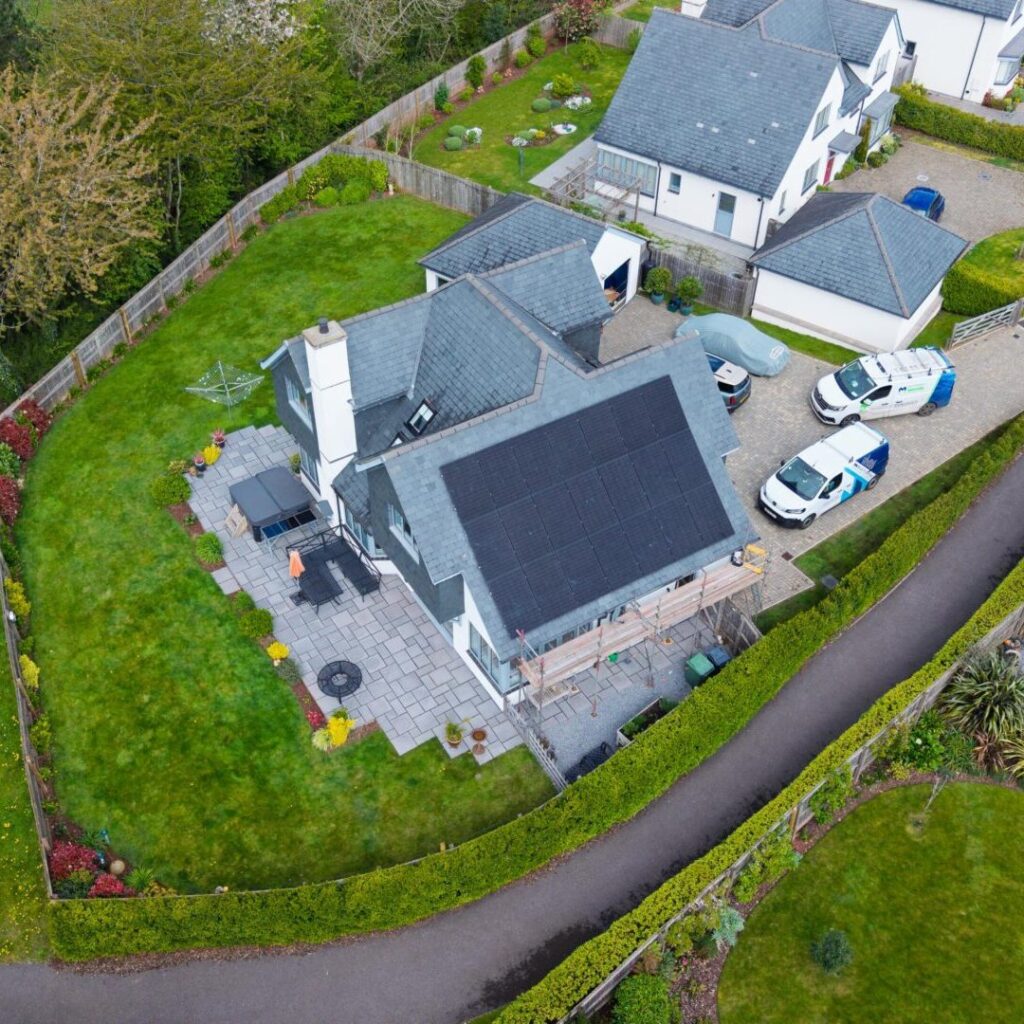

At a glance:
Solar panels are now a standard requirement for most new build homes in England under the 2021 update to Part L of the Building Regulations (effective from June 2022). For self-builders, developers and housing associations in Devon building new homes, MCS-accredited solar installation is both a regulatory requirement and a practical investment. M&E Contrax installs solar PV for new builds across Devon, working with developers, main contractors and self-builders from planning stage through to handover.
New build solar in Devon is a distinct market from retrofit. The requirements are different, the installation process is different, and the relationship with the main contractor or developer is a key factor in getting the system right. This page explains what new build solar involves, what Part L requires, what MCS certification means for a new build property, and how to involve M&E Contrax at the right stage of the build.
Part L and New Build Solar: What the regulations require
Part L (Conservation of Fuel and Power) of the Building Regulations sets the energy efficiency standard for new homes in England. The 2021 update, introduced from June 2022, represents a significant tightening of these standards, with the target of achieving a 31% improvement in carbon emissions compared to the previous standard.
In practice, this means that most new homes now need to demonstrate a combination of fabric efficiency (insulation, airtightness, glazing) and low-carbon energy generation. Solar PV is not explicitly mandated by Part L, but it is the most practical and cost-effective way to meet the required carbon performance for the majority of new builds. SAP (Standard Assessment Procedure) calculations, the methodology used to demonstrate compliance, consistently show solar PV as the most efficient route to compliance for standard house types.
In straightforward terms: if you are building a new home in Devon in 2026, almost certainly it needs solar panels to pass Building Control.
What’s different about new build solar?
Installing solar on a new build is a different process from retrofitting panels to an existing home. The key differences are:
Integration with the build programme
Solar needs to be planned into the build from the outset, not bolted on at the end. The roof structure, cable routes, consumer unit specification and battery location (if included) all need to be determined at the design stage. Leaving solar to the end of the programme typically results in remedial work to the structure, unnecessary disruption to trades already on site, and additional cost.
SAP compliance and design
The solar system must be sized to meet the SAP target for the property. The Standard Assessment Procedure calculation tells you exactly how many kilowatts of solar generation are needed, which determines the number and type of panels, the orientation and pitch requirements, and whether battery storage is needed to meet the carbon target.
MCS certification for the new build property
An MCS certificate is required for the solar installation on a new build property, just as it is for retrofit. The MCS certificate is:
Required for the property to access the Smart Export Guarantee from day one of occupation
Required for the VAT zero-rating on the solar element of the build (subject to HMRC rules on new build VAT)
Required by most mortgage lenders with green mortgage products that require certified renewable energy systems
Expected by buyers as standard evidence that the system was properly installed
Coordination with main contractor
On a developer-led new build project, the solar installer needs to work within the main contractor’s programme. We are experienced in coordinating with site managers and main contractors, agreeing access, ensuring cable routes are left clear by first fix electricians, and fitting around the programme rather than disrupting it.
Self-build solar in Devon
Devon has an active self-build sector, with the rural county and its planning landscape attracting buyers who want a custom home rather than an estate property. Self-builders have more control over the design process than volume developers, which means better opportunities to integrate solar from the ground up.
For self-builders, the right time to involve a solar installer is at the architectural design stage. The roof pitch, orientation, ridge height and internal cable routes can all be optimised for solar performance before the plans are finalised. A south or south-west facing roof at 30 – 45 degrees pitch with no shading from neighbouring structures or trees will deliver the best yield.
M&E Contrax works directly with self-builders and their architects across Devon, providing:
Input at design stage on panel placement, cable routes and inverter/battery locations
SAP-compatible system design to meet Building Control requirements
Installation coordinated around the build programme
Full MCS certification on completion
Handover documentation for Building Control sign-off
Solar for small housing developers in Devon
For small and medium-sized housing developers building schemes of two to twenty units in Devon, solar is no longer optional, it is a planning and Building Regulations requirement in most cases. Many local planning authorities in Devon also require solar as a condition of planning permission for new housing, independently of Building Regulations.
Working with an MCS-accredited contractor on the solar element of a development brings several advantages:
Single point of responsibility: one contractor for all units on the development, with consistent installation quality and documentation
Programme efficiency: we work within the development programme and can install across multiple units simultaneously where programme allows
Handover documentation: each unit receives its own MCS certificate and commissioning documentation, ready for the buyer information pack
SAP compliance: systems are designed to meet the SAP target for each plot, not a one-size-fits-all approach
Battery storage on new builds
Including battery storage on a new build is significantly cheaper and simpler than adding it later. At build stage, cable routes can be installed to accommodate a battery system at a fraction of the retrospective cost, and the battery location can be specified in the design (plant room, utility room, garage) rather than fitted to whatever space is available in an existing home.
From an SAP perspective, battery storage can also contribute to Part L compliance by reducing peak import demand from the grid. For plots where the standard solar array alone does not quite meet the SAP target, a battery can close the gap.
We install a range of battery systems on new builds, including Sigenergy and FoxESS commercial storage systems that are well suited to developer applications. For larger development schemes, we can specify a consistent battery platform across all units to simplify maintenance and homeowner support.
VAT on new build solar
VAT on new build properties is a specialist area, and the rules for solar on new builds differ from retrofit. The supply and installation of solar panels as part of a new build construction project is generally treated as part of the new build itself, which is zero-rated for VAT under HMRC’s new build VAT rules. This is different from the zero-rating that currently applies to retrofit solar installations (which applies until 31 March 2027).
Speak to your accountant or VAT adviser to confirm the correct VAT treatment for your specific build, the rules around VAT on solar for mixed-use buildings and for partially completed builds can be complex.
Talk to us about new build solar in Devon
Whether you are a self-builder planning your own home, a small developer building a residential scheme, or a housing association developing affordable housing in Devon, M&E Contrax can provide MCS-accredited solar installation coordinated around your build programme.
Get in touch at the design stage for the best outcome, we can advise on system design, SAP implications, and programme integration before ground is broken.
FAQs
In most cases, yes. The 2021 update to Part L of the Building Regulations requires a significant improvement in carbon performance for new homes, and solar PV is the most practical route to compliance for the majority of standard house types. Many local planning authorities in Devon also require solar as a planning condition, independently of Building Regulations.
As early as possible, ideally at architectural design stage. The roof specification, cable routes and plant room space all affect the solar installation. Specifying solar early avoids abortive work and ensures the system is integrated into the build rather than fitted to whatever remains at the end.
Yes. MCS certification is required for the Smart Export Guarantee, for green mortgage products, and as standard evidence for buyers. On a developer-led scheme, each plot should receive its own MCS certificate as part of the handover documentation.
Yes. We work on multi-plot residential developments across Devon. For developer schemes, we can install across multiple units within the development programme, using a consistent system specification across all plots and providing per-unit MCS certificates for the buyer information pack.
South-facing or south-west facing roof slopes at 30 – 45 degrees pitch deliver the best annual yield. East-west orientations can work for split systems where the total panel area is sufficient to meet the SAP target. We advise on the optimal configuration for each plot at design stage.
Yes, and doing so at build stage is significantly cheaper than adding storage later. Cable routes can be included in the first fix electrical works, and the battery location can be specified in the design. Battery storage can also assist with Part L SAP compliance where the standard solar array alone is insufficient.


